
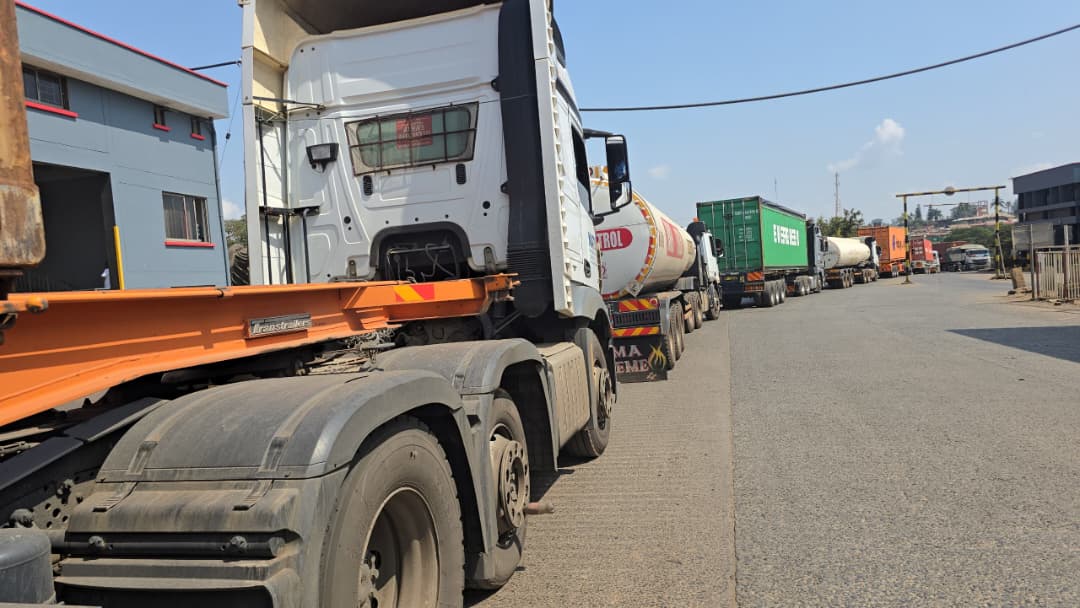
A traffic snarl stretching nearly 35 kilometres into Kenya has crippled operations at the Malaba border crossing, with truck drivers, transporters and clearing agents blaming the Uganda Revenue Authority's (URA) reinstatement of metallic electronic cargo seals for the prolonged delays.
The congestion, which has persisted for the past three days, has transformed one of East Africa's busiest border posts into a major bottleneck, leaving the Ugandan side unusually quiet as only a limited number of trucks manage to cross into the country each day.
Truck drivers say the revised cargo clearance procedure has significantly slowed cross-border movement. Previously, cargo was fitted with an electronic tracking seal at the point of loading. Under the reinstated system, however, every truck is now required to receive an additional metallic electronic seal at the border, increasing processing time for each vehicle.
Drivers say the delays have exposed them to insecurity and harsh living conditions, forcing many to spend days stranded along the highway without adequate access to food, sanitation facilities or safe places to rest.
"We have nowhere to eat, nowhere to sleep, and nowhere to help ourselves. We are suffering," said truck driver Samuel Njoroke.
Another driver, Yusuf Hadith, warned that prolonged waiting without adequate rest is increasing the risk of road accidents.
"We are not sleeping and that is becoming very dangerous on the road," he said.
Transporters say the delays are also inflicting significant financial losses. They report consuming more fuel than planned while perishable goods worth millions of shillings risk spoiling before reaching their destinations.
Abel Namenge of the Kenya Long Distance Truck Drivers Union said some truck drivers have also become targets of criminals while stranded in the long queues.
"Some of us are transporting goods that are ready for the market. We are being attacked on the road and our cargo stolen. We have nowhere to eat, yet we are also human beings," he said.
Clearing agents say the reinstated cargo sealing requirement has drastically reduced the number of trucks processed daily.
Chrispinus Omuse of the Kenya International Freight and Warehousing Association (KIFWA) said the number of trucks cleared each day has dropped from between 1,500 and 1,600 to about 750.
In response, URA Eastern Region Manager Abbey Mawerere defended the decision to reinstate metallic cargo seals, saying the measure was introduced to curb increasing cases of cargo theft reported after the seals were temporarily suspended.
"We discovered that during the period when metallic cargo seals had been suspended, some dishonest individuals started stealing cargo. That is why we decided to resume sealing every truck," Mawerere said.
He acknowledged the disruption caused by the long queues but assured transporters that URA staff are working around the clock to clear the backlog and restore normal operations by tomorrow.
However, transporters and clearing agents have rejected the assurance, calling for the immediate suspension of the reinstated sealing system.
Peter Sireka, Chairperson of the Uganda Clearing Industry and Forwarding Association (UCIFA), criticised the implementation of the directive, arguing that stakeholders were not adequately consulted before the changes were introduced.
"We want this directive suspended. Such decisions should not be implemented from the head office without first assessing the situation on the ground," he said.
Simon Okwi of the Kenya Transporters Association (KTA) warned that transporters could suspend operations if the matter is not resolved within the next two to three days.
"We are giving them only two to three days. If nothing changes, we shall mobilise our drivers to stop working. This cannot continue in Uganda," he said.
The standoff now threatens to disrupt trade along the Northern Corridor, East Africa's busiest transport route linking the Port of Mombasa to Uganda, Rwanda, South Sudan, eastern Democratic Republic of Congo and other landlocked countries.
Any prolonged disruption at Malaba could affect regional supply chains, increase the cost of transporting goods and delay deliveries across several East African markets, further highlighting the strategic importance of efficient border operations.
